Digital delivery
Website + CRM
Public presence and an internal working system.
A public website and a custom CRM, built around the partner business’s requirements and now in use for business development.
Website + CRM
Digital delivery
In use
CRM status
Partner venture
Relationship
NxtGen Trophies needed both a credible public website and an internal system capable of supporting a manual-first sales and enquiry workflow.
The customer experience and internal operating model had to develop together, without imposing unnecessary automation on an early-stage business.
As a director and partner in NxtGen, Charlie developed the public presence and a working CRM around the directors’ requirements. The team now uses the system for business development; development continues as those requirements evolve.
The priority was a usable foundation: clear offers and enquiry routes on the outside, structured customer and organisation records on the inside.
The CRM gives the directors a shared place to organise customer and organisation information, enquiries and next actions. Activity and task management sit alongside the records, supporting the practical work around potential and existing customers. Quotation and email workflows remain in development.
The system is functional and is being used by the directors for business development. Responsive mobile web-app access is available with a network connection. Development continues as the team’s requirements evolve.
The public website explains NxtGen’s offer. The internal CRM organises the directors’ business-development activity. Together they demonstrate public-facing website delivery and a custom operational system within a partner venture.
The website translates the NxtGen offer into a clear customer journey: browse the catalogue, build a package or request a quotation using known product codes.
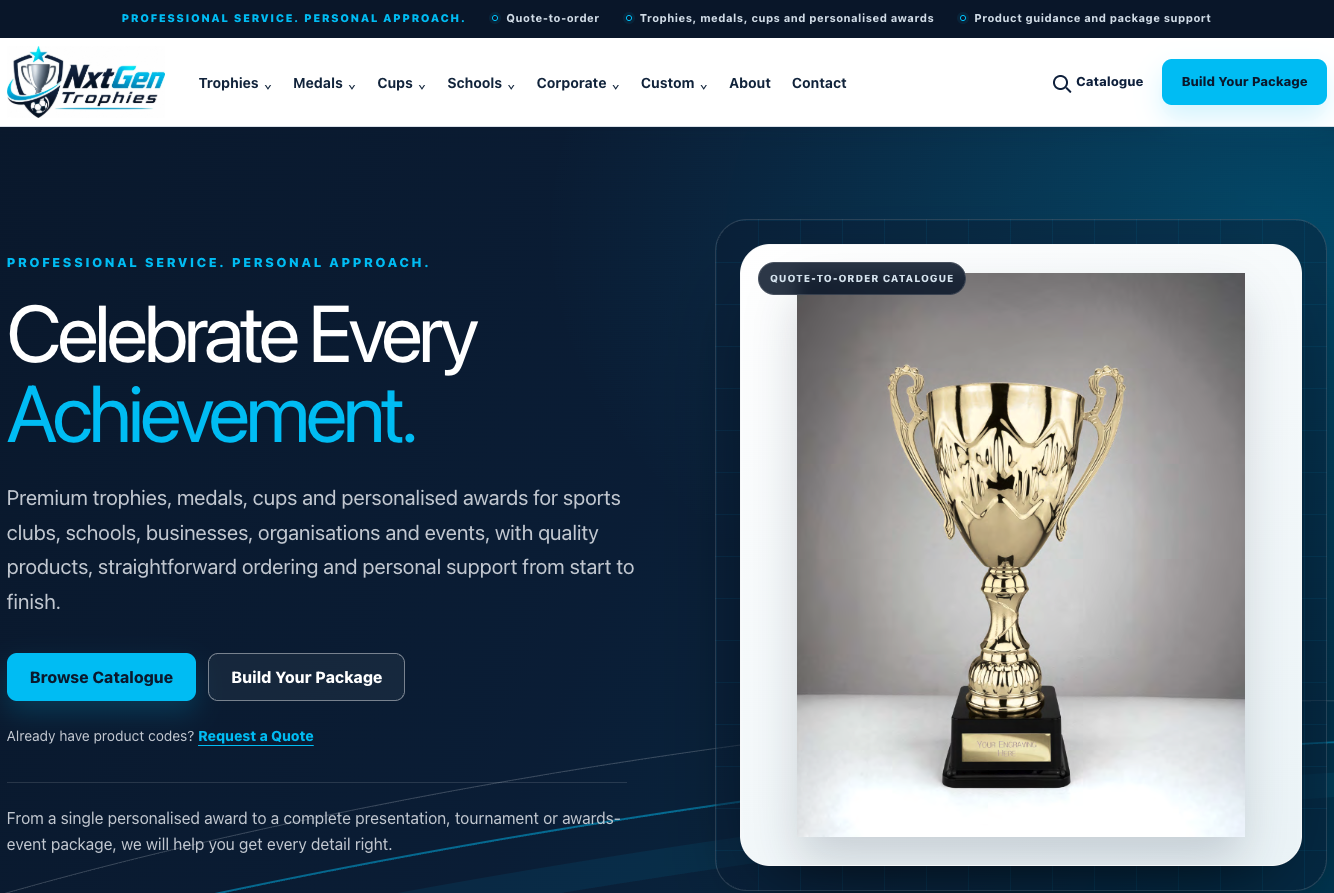
The public website and the internal CRM perform different jobs. The website explains the NxtGen offer and gives customers a route to enquire. The CRM helps the directors organise the information and follow-up once work is being handled internally. The evidence below does not imply an automatic website-to-CRM transfer.
The fictional Demo Club A record holds the organisation type, activity, adult contact, explanatory note and dated next action. A director can inspect the relationship context before contacting the club, rather than relying on a separate spreadsheet row or inbox thread.
The enquiry records the occasion, requested personalisation and relevant dates while leaving quantities visibly unconfirmed. It gives the director enough context to ask the next question without presenting the fictional request as a completed quotation.
The organisations view shows Demo Director B as owner and the action to confirm quantities and the engraving deadline. That presentation supports an intended handover: another director can inspect the task and linked context. The static evidence does not prove concurrent use or permission enforcement.
The task view keeps the action, due date, priority, linked enquiry and note readable at a mobile viewport. It supports useful browser access with a network connection. It is not evidence of a native application, offline operation or every CRM function being available on a phone.
Development status: organisation records, enquiry presentation, ownership, activity, tasks and responsive mobile web-app access are evidenced in the current interface. Quotation and email/correspondence workflows remain in development unless separately established by current production evidence. Automatic website import, payment, stock and accounting workflows are not claimed.
Considering a similar operational system? Explore Custom CRM Systems → or see how Saxon Bridge is developing its own SalesOS product →.
Digital delivery
Website + CRM
Public presence and an internal working system.
CRM status
In use
Used by the directors for business development.
Relationship
Partner venture
Charlie has a direct ownership interest.
Measures describe the systems delivered and the relationship context, not future commercial results.
Early-stage systems work best when it follows the operators' real workflow and leaves room for the business to mature.